
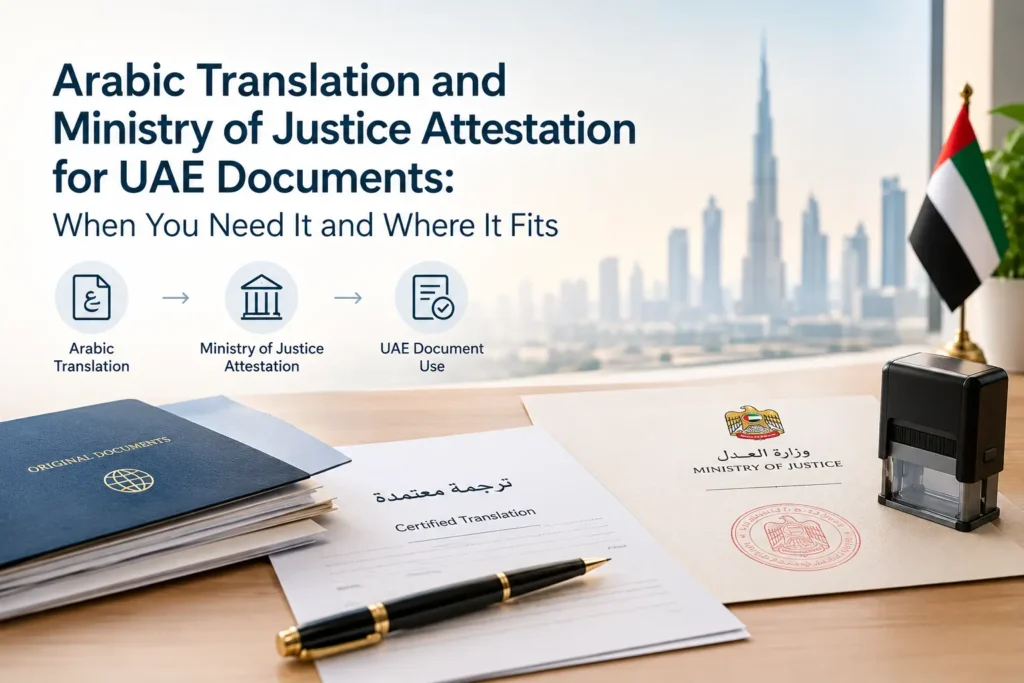

You have finished the long attestation process on your certificate, and then an office in the UAE asks for an Arabic translation. It happens often, and it catches many people late. Once a document has been through certificate attestation, the UAE has confirmed it is genuine. That is a separate question from whether the receiving office can read it, and some offices want both.
This guide explains what each one is, why the UAE asks for translation, which documents usually need it, and the order of steps to follow.
Quick answer
- Attestation verifies that your original foreign document is genuine.
- Arabic translation is done by a legal translator licensed by the UAE Ministry of Justice (MOJ).
- The MOJ then attests the translator’s signature, not your certificate.
- Whether you need translation depends on the office receiving the document, so ask before you translate.
What Arabic translation and MOJ attestation actually are
Attestation is a chain of government checks on the original document: notary, home-country authorities, the UAE Embassy, then the Ministry of Foreign Affairs. The final UAE-side stamp is MOFA attestation, and once it is complete, the UAE has confirmed the original is genuine.
Translation answers a different question: can the receiving office read it? A legal translator licensed by the MOJ puts the document into Arabic, then signs and stamps the translation. The MOJ attests that signature.
So there are two checks on two different things. MOFA stands behind the original. The MOJ stands behind the translation.
Why the UAE asks for an Arabic translation
Arabic is the official legal language of the UAE. Courts, notaries and the Ministry of Justice work in Arabic, and some immigration and family-visa processes ask for it too. Take a power of attorney signed abroad and used to open a bank account or transfer property. The bank or land office has to rely on it legally, so it needs a version it can read, produced by someone accountable to a UAE authority.
That is why the translator has to be MOJ-licensed. A translation from an unlicensed source is unlikely to be accepted, however accurate it is.
Which documents usually need it
There is no single rule for every document, because the requirement comes from the office that receives it. These are the cases we see most.
Family documents for a residence visa
Sponsoring a family member is where most people run into this. Many applicants complete marriage certificate attestation for a spouse visa and only then learn that an Arabic version is also required. In our experience this surprises many clients.
Powers of attorney and other legal papers
Powers of attorney are used in courts, banks and property matters, which are exactly the places that work in Arabic. A missing translation is a common reason legal and commercial documents are returned.
Company documents
If you are setting up a company, the memorandum and articles of association are prepared in English in many countries. They may need translation before the licensing office will take them.
Degrees and experience letters
For a job visa, the answer varies. Some employers and PROs accept English originals, and others ask for Arabic. Ask your employer’s PRO what they want before you pay for a translation. Employment files are also handled differently from family ones, and attestation for job visa vs family visa in UAE shows how the document sets differ.
If your certificate was issued in Arabic, you do not need a translation. It still needs attestation.
Where translation and MOJ attestation fit in the process
The order depends on the language of your document and on who receives it.
A document already in English or Arabic, going to a UAE court, notary or ministry that wants Arabic. The usual order is:
- Home-country attestation. Notary, state or home department, and the foreign ministry. For Indian documents this includes the MEA.
- UAE Embassy or Consulate attestation in the country that issued the document.
- MOFA attestation.
- Certified Arabic translation by an MOJ-licensed translator.
- MOJ attestation of the translation.
A document in neither English nor Arabic. Translation comes earlier. MOFA typically wants a certified translation before it attests, and a missing one is among the common reasons MOFA rejects attested documents.
Family-visa documents. In our experience, marriage and birth certificates often need the translation before they go to MOFA. In every case, confirm the order with the receiving office first.
Step-by-step: what to do
1. Find out who wants the document, and in what form
Ask the receiving office, or your employer’s PRO, three things. Do they want Arabic? Must the translation be MOJ-attested? Do they want it before or after MOFA? Get the answers in writing if you can.
2. Check the original
Look at the names, dates and certificate type before anything else. Names should be spelled exactly as in your passport. Use the final certificate, not a provisional one. Do not laminate it, because attestation departments do not stamp completely laminated documents. A name mismatch is the most common preventable rejection we see, which is why we verify each document before submission.
3. Complete the attestation chain
Gather everything each stage needs before you begin, and complete the stages in order. Each stage checks the stamp before it, so skipping ahead invalidates the chain.
4. Choose a licensed translator
Confirm that the translator holds an MOJ licence. Ask whether they also take the translation through MOJ attestation, or whether you need to arrange that yourself.
5. Review the translation before it is stamped
Compare names, dates, places and registration numbers against the original. Check the Arabic spelling of every name against the passport. Fixing an error after the stamp is slower and costs more.
6. Complete the MOJ attestation
The translator’s signature is attested by the Ministry of Justice. After this step, the translation is ready to submit.
7. Submit the full set
Keep the attested original, the Arabic translation and the MOJ stamp together. Each document is translated and attested on its own. A family sponsoring a spouse and children is dealing with several translations, since each child’s birth certificate attestation is a separate file.
A newer detail: the combined legalisation page
Law firms reported in early 2026 that UAE consulates abroad have started issuing an electronic legalisation page. In some cases this page carries the MOFA attestation as well as the consulate’s. A separate MOFA step inside the UAE may then not be needed, and what remains is the Arabic translation and its MOJ attestation. Rouse describes the change.
This is reported as applying only in certain cases, so look at the page you actually receive. If it shows both seals, ask before paying for a second MOFA step. The page is issued at the embassy stage, and the UAE Embassy attestation process is worth reading alongside it, since that stage has seen recent updates.
Common mistakes that cost time
- Translating too early. A translation made before you know which office wants it can be wasted if the original is later rejected.
- Using a translator who is not MOJ-licensed. The translation may not be accepted.
- Skipping the MOJ attestation. If an office asks for an attested translation, a stamped translation on its own will not do.
- Names that do not match the passport. Ask the translator to follow the passport spelling.
- Leaving no time. Translation and MOJ attestation add time on top of the attestation itself.
How long does it take?
We do not give a fixed number for the translation and MOJ stages, because it depends on the translator, the document and the queue at the time. Ask the translator for a timeline before you start. For the attestation stages themselves, the certificate attestation timeline in Dubai sets out what to expect. Plan the translation on top of that, not inside it.
Frequently asked questions
Does attestation include Arabic translation?
No. Attestation verifies the original document. Translation is a separate step done by an MOJ-licensed translator.
Who can translate my document?
A legal translator licensed by the UAE Ministry of Justice.
Does the MOJ attest my certificate?
No. The MOJ attests the translator’s signature on the translation. Your certificate is attested by MOFA.
Is an English certificate accepted without translation?
MOFA accepts documents in English or Arabic. The question is who receives the document next. Courts, notaries and the MOJ normally ask for Arabic, and other offices may accept English. Check before you pay for a translation.
My certificate is already in Arabic. What do I do?
You do not need a translation, but the certificate still needs attestation. The documents required for certificate attestation in Dubai are listed in full, so you can prepare them in advance.
Can I translate first and attest later?
For documents in neither English nor Arabic, and for some family-visa documents, the translation comes before MOFA. If you do not know the order for your document, ask the receiving office first.
Need help with your documents?
Green Line Attestation handles the attestation chain from notary to MOFA, with doorstep collection across the UAE and WhatsApp updates at each stage. Before anything is submitted, we check whether the receiving office will also want an Arabic translation, so you hear it from us and not from a rejection.
Send us a photo of your document and tell us where it will be submitted. You can contact our team or message us on WhatsApp.