

A job offer from a Dubai private school is only the first half of becoming a teacher there. Before you can stand in front of a class, the Knowledge and Human Development Authority (KHDA) has to approve your file, and that approval rests entirely on paperwork KHDA can trust: your degree, your teaching qualification, and your police clearance, each one verified through a formal chain rather than taken at face value. Teaching is one of several professions in the UAE with its own dedicated regulator, which is why attestation requirements differ depending on what you do for a living, for teachers specifically, which authority you answer to depends on where you work and what kind of school it is.
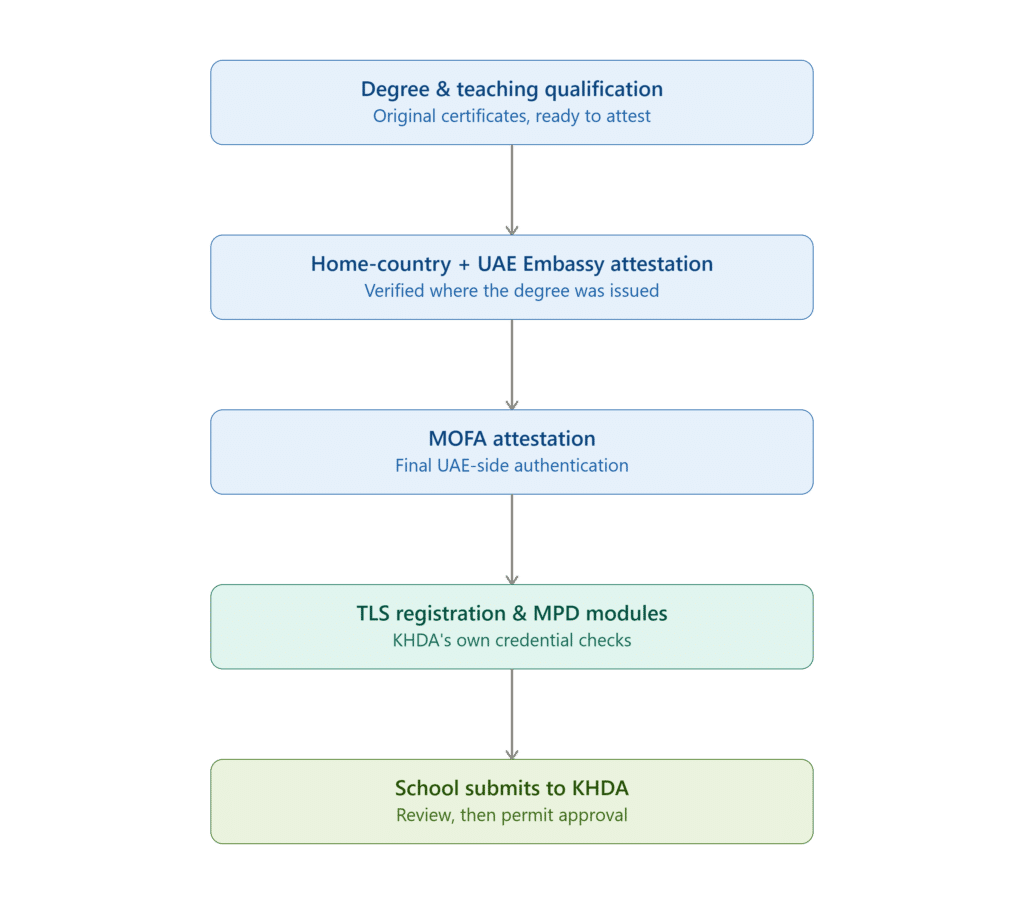
Quick answer: what does a teacher need for KHDA approval?
- Home-country attestation of your degree and teaching qualification
- UAE Embassy attestation in the country that issued them
- UAE Ministry of Foreign Affairs (MOFA) attestation, the final UAE-side stamp
- Registration on the Teachers Licensing System (TLS), KHDA’s platform for verifying educator credentials
- Completion of the five Mandatory Professional Development (MPD) modules
- Submission through your school, since KHDA permits are filed by the employing school rather than the teacher directly
Attestation confirms your certificates are genuine. TLS and MPD are KHDA’s own checks on top of that. All three need to be in place before the permit is issued, and because the school submits the file, none of this can move faster than your own paperwork allows.
KHDA, ADEK, or the Ministry of Education: who actually regulates you?
This is the question most guides skip, and it changes everything about which portal, permit and timeline you’re dealing with:
| KHDA | ADEK | UAE Ministry of Education | |
|---|---|---|---|
| Jurisdiction | Private schools in Dubai | Private and public schools in Abu Dhabi | Public (government) schools nationwide, plus private schools outside Dubai and Abu Dhabi |
| Portal/system | TLS (Teachers Licensing System) | ADEK’s own educator registration system | MOE recruitment and licensing channels |
| Who files the application | Your employing school | Your employing school | MOE or the relevant Local Education Authority |
| Training requirement | Five MPD modules | ADEK’s own induction/professional development requirements | Varies by emirate and contract type |
If you’ve had offers from schools in more than one emirate, this is the first thing to check, because the attestation chain on your documents is identical everywhere, but the portal, the training modules and the approving authority are not.
Why KHDA approval matters
KHDA regulates private education across Dubai, and no private school can legally put an unlicensed teacher in a classroom. The KHDA Teacher Permit (sometimes called an Appointment Notification) is the credential that makes you legally employable as a teacher in the emirate, and it’s tied to a specific school rather than being a general license you carry between employers. Move schools, and the permit process starts again with your new employer, even though your attested documents themselves don’t need re-attesting.
Your school’s HR team typically drives the paperwork, but the underlying documents, degree, teaching qualification, transcripts, police clearance, are yours to attest before the file can be submitted.
Documents you’ll generally need
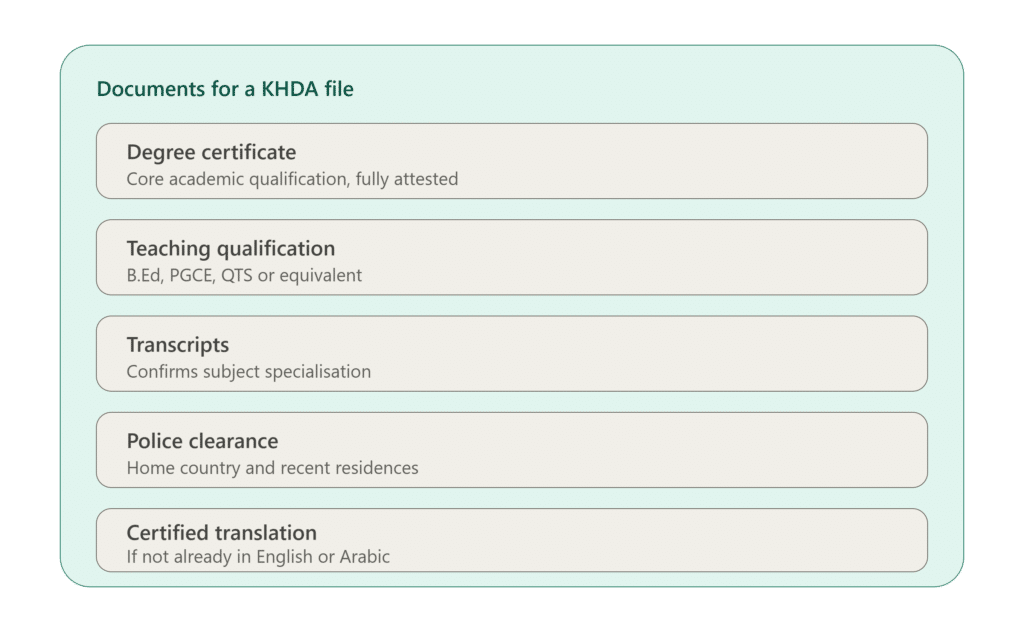
The exact list can vary by role (nursery, primary, secondary, specialist subject) and by nationality, so confirm the final requirements with your school’s HR team. As a starting checklist:
| Document | Why it’s needed |
|---|---|
| Original bachelor’s degree (or equivalent), fully attested | Core qualification for the subject or age group you’ll teach |
| Teaching qualification (B.Ed, PGCE, QTS, or equivalent), attested | Required where your degree alone isn’t a teaching qualification |
| Academic transcripts | Confirms your major aligns with the subject you’re hired to teach |
| Police clearance certificate | From your home country and any country you’ve lived in during the past 5–10 years |
| Passport copy and UAE visa/Emirates ID, where applicable | Identity verification |
| Experience letters | Supports the experience thresholds KHDA sets for each teaching level |
| Certified translation | Needed for any document not already in English or Arabic |
How attestation fits into the KHDA file
Teaching credentials go through the same three-stage process as any other foreign document used in the UAE: verified in the country that issued them, legalised at the UAE’s embassy there, then finalised at MOFA. We’ve broken that process down in full, apostille rules included, in our guide to how educational document attestation works in the UAE. What’s specific to teachers is what happens before and after that chain: KHDA wants both your degree and a separate teaching qualification attested, not just one or the other, and an apostille from a Hague country still doesn’t bypass the UAE Embassy or MOFA stages.
If you qualified in India, the state-level and MEA steps that come first and the same route applies whether the degree certificate attestation is for a teaching role or any other profession. Whatever country issued your documents, the final UAE-side stamp is MOFA attestation, which KHDA treats as non-negotiable before a file moves forward.
TLS registration and the five MPD modules
Attestation gets your documents recognised. Two more things sit on top of that before KHDA issues a permit:
- Teachers Licensing System (TLS) registration — KHDA’s platform for recording and verifying educator qualifications and professional history, and the system your school uses to confirm your file against KHDA’s own records rather than taking your paperwork at face value.
- Mandatory Professional Development (MPD) — five compulsory training modules covering areas like child protection and safeguarding and the KHDA Educator Code of Conduct. Completion is evidenced by a KHDA-recognised certificate, which becomes part of your file alongside your attested degree.
Neither of these replaces attestation. They run alongside it as separate requirements KHDA checks before approval, and skipping either one stalls a file that otherwise has perfect paperwork.
Minimum qualifications by teaching role
KHDA sets different minimum qualifications depending on the age group or subject you’re hired to teach, generally benchmarked against the QF Emirates (Qualifications Framework Emirates) levels used across UAE education and accreditation:
- Nursery teachers generally need a recognised qualification plus relevant experience with that age group.
- Pre-KG/Foundation Stage teachers typically need at least a bachelor’s-level qualification (QF Emirates Level 6 or equivalent) and recent experience teaching that age range.
- Specialist subject teachers (primary or post-primary) generally need a recognised bachelor’s degree in or closely aligned with the subject they’ll teach, plus at least a year of recent relevant experience. A biology graduate applying for a physics role, for instance, may be asked for additional evidence that the specialisation lines up with the timetable they’d actually teach.
University professors are generally outside this framework altogether, since higher education in the UAE sits under the Ministry of Higher Education and Scientific Research (MoHESR) and the Commission for Academic Accreditation rather than KHDA’s school-teacher licensing system.
How long does a KHDA teacher approval stay valid?
This varies by individual case, reported ranges run from one to three years depending on qualifications and assessment outcomes, and it’s one of the few points in this process worth confirming directly with your school or KHDA rather than assuming a fixed figure, since the determining factors aren’t uniform across every teacher. What is consistent is that renewal isn’t automatic: it depends on staying employed at a KHDA-licensed school and continuing to meet KHDA’s requirements, including ongoing professional development.
Step-by-step: from attestation to KHDA approval
- Confirm the exact document list with your school’s HR team, since requirements shift slightly by role and nationality.
- Have your documents checked before you submit anything. A mismatched name, an unclear transcript, or a missing stamp can stall a file at any stage, which is why we verify each document before submission.
- Complete home-country and UAE Embassy attestation for your degree and teaching qualification.
- Complete MOFA attestation in the UAE.
- Register on the Teachers Licensing System and complete the MPD modules.
- Hand your attested documents to your school’s HR department, who compile and submit the full KHDA application.
- Allow time for KHDA’s review, which includes background screening against its own records.
[Image suggestion: numbered step graphic matching the 7 steps above, usable as a shareable Pinterest/LinkedIn asset. Alt text: “Steps from certificate attestation to KHDA teacher approval.”]
Common mistakes that delay teacher permits
- Subject mismatch. Your degree major needs to align with what you’re hired to teach, particularly for specialist subject roles.
- Degree without a teaching qualification. A standalone bachelor’s degree often isn’t enough; a B.Ed, PGCE, QTS or equivalent may be required alongside it.
- Incomplete police clearance. KHDA typically wants certificates from your home country and from every country you’ve lived in over the past several years, not just your current one.
- Assuming an apostille is sufficient. It isn’t, regardless of your home country’s Hague status.
- Submitting documents out of sequence. Each stage checks the stamp before it, so skipping ahead invalidates the chain.
- Overlooking the MPD modules. Attested documents alone don’t complete a KHDA file; the training modules are a separate requirement.
- Letting the school submit before attestation is finished. Since the school files on your behalf, an incomplete attestation chain on your end stalls the whole application.
- Assuming KHDA requirements carry over to a school in Abu Dhabi or another emirate. They don’t — see the comparison above.
KHDA isn’t the only profession-specific authority
Nurses answer to health-sector regulators instead, with licensing routed through DHA, DOH and MOHAP rather than an education authority. Engineers, meanwhile, register with a dedicated professional society instead of a government department. The attestation groundwork is the same across all three; the regulator at the end, and what it checks beyond your documents, isn’t.
Frequently asked questions
Do I need both a degree and a separate teaching qualification attested?
In most cases, yes, if your degree isn’t itself a teaching qualification. A B.Ed is often sufficient on its own, while a non-education degree is often paired with a PGCE, QTS or equivalent.
Can I start teaching in Dubai while my KHDA permit is still being processed?
No. Schools are expected to have a valid permit in place before a teacher takes up a classroom role.
Does KHDA accept an apostilled certificate instead of embassy and MOFA attestation?
No. KHDA has stated it will not accept documents without the home-country and UAE MOFA stamps, regardless of apostille status.
If I’m approved by KHDA, am I automatically approved to teach in Abu Dhabi too?
No. ADEK runs its own registration process for Abu Dhabi schools. Your attested documents transfer, but the approval itself doesn’t.
Who submits the KHDA application, me or my school?
Your school submits it on your behalf, using the attested documents and other paperwork you provide.
How long does the whole process take?
It depends on your country of qualification, how quickly your documents clear each stage, and how promptly your school processes the TLS and MPD steps. Build in weeks rather than days.
Do substitute or part-time teachers need the same attestation?
Generally yes. KHDA’s licensing requirements apply to teaching staff in KHDA-regulated schools regardless of contract type, though it’s worth confirming with your specific school.
Does my KHDA approval expire if I change schools?
The underlying attested documents stay valid, but the permit itself is tied to your employing school, so a new employer generally restarts the KHDA filing process.
Get your teaching credentials attested without the back-and-forth
A KHDA file moves only as fast as its slowest document. Greenline Attestations verifies your degree and teaching qualification, manages the full attestation chain from home-country verification through MOFA, and keeps you updated at each stage so your school can submit a complete file the first time. Contact our Dubai team to get started.