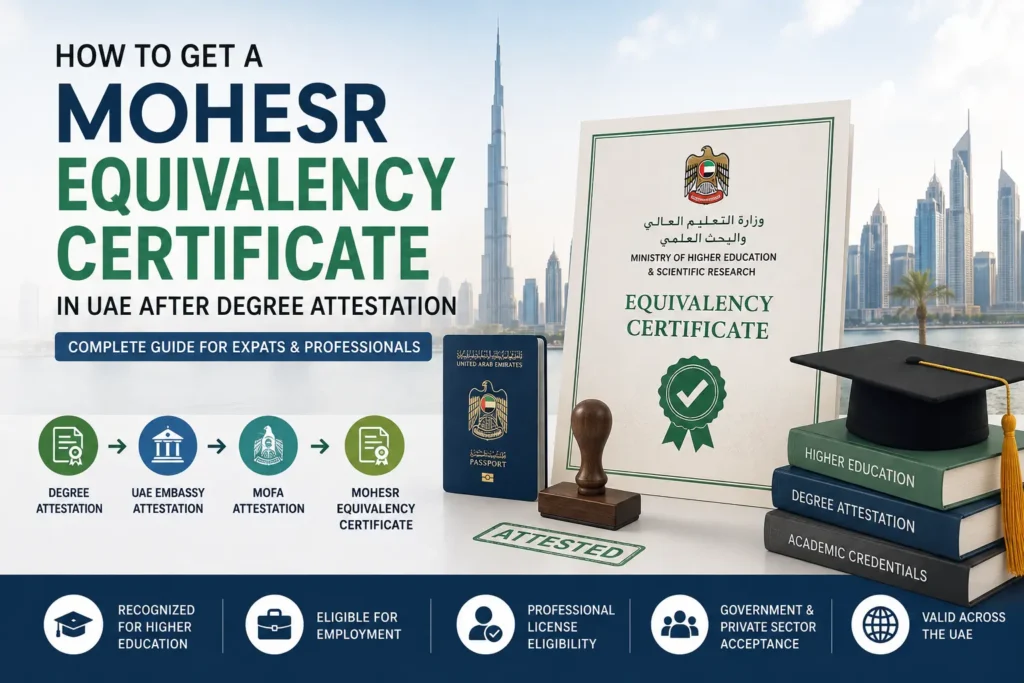

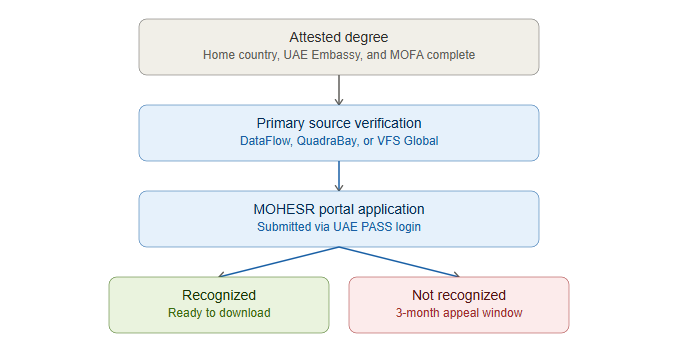
Once your degree is attested, getting a MOHESR equivalency certificate officially a Recognition Report comes down to two stages: independent verification through DataFlow, QuadraBay, or VFS Global, then a formal application on the MOHESR portal. This guide walks through both, in the order applicants actually hit friction, based on where we’ve seen documents get stuck in practice including the one distinction that trips up more people than anything else here: the Ministry’s new Automatic Recognition system only covers a specific list of UAE universities, not any foreign degree, however prestigious.
Quick summary:
- Two stages: primary source verification (DataFlow/QuadraBay/VFS Global) → MOHESR portal application
- Fees: AED 300–1,500 for verification, plus an AED 100–200 government fee by qualification level
- Timeline: roughly six weeks to three months end to end, on top of attestation
- Who needs it: government roles, licensed professions, some Golden Visa categories not a standard private-sector visa
- Terminology: officially a “Recognition Report” since November 2024, on the MOHESR e-services portal still widely called an equivalency certificate
Before You Begin: Confirm Your Degree Is Already Attested and That You Actually Need This
MOHESR’s recognition process is built on top of an already-attested degree, not instead of it. If you haven’t completed that chain yet home country notarisation, Ministry of External Affairs (or equivalent) authentication, UAE Embassy legalisation, and MOFA attestation start there first; our Indian degree certificate attestation guide covers that full sequence. Applying for recognition with an incomplete attestation chain is one of the most common reasons applications stall before verification even begins.
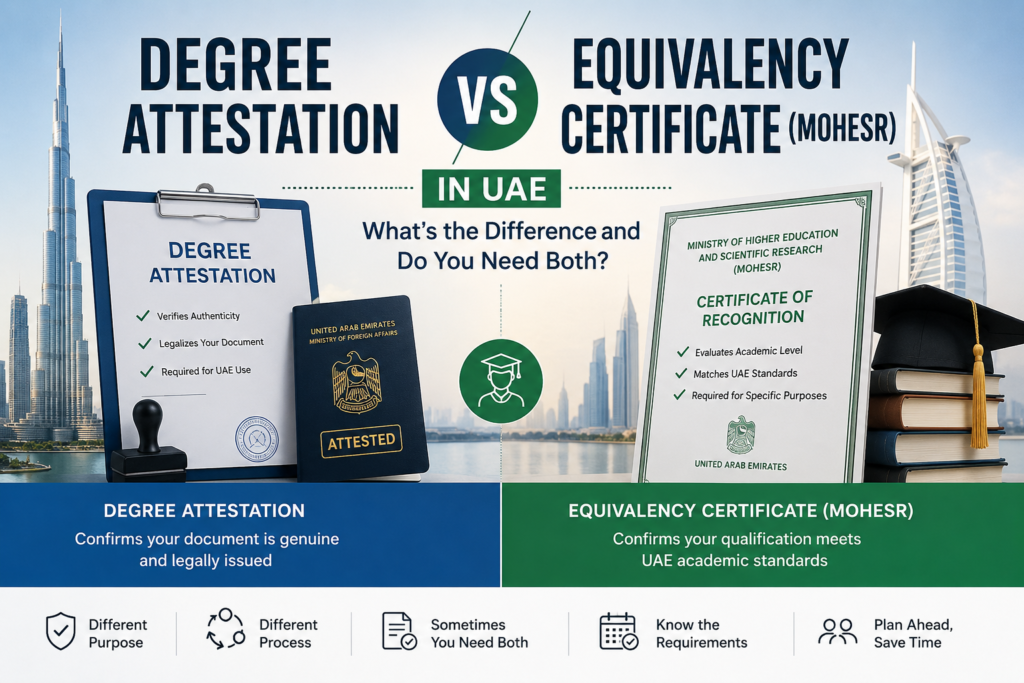
Worth double-checking at this stage, too: not everyone with an attested degree needs to go further and apply for recognition it’s generally required for government roles, licensed professions, certain Golden Visa categories, and specific employer requests, but not for a standard private-sector visa where an attested degree alone is enough. If you’re not sure which category you fall into, it’s worth working through what actually separates degree attestation from a MOHESR equivalency certificate before spending time and fees on an application you may not need.
One caveat worth flagging honestly: most guidance, including the comparison above, treats attestation as a strict prerequisite for the entire recognition journey. A small number of sources including one citing VFS Global, MOHESR’s authorized verification partner suggest the initial verification stage may only require clear scanned copies, with a fully attested degree needed only at final submission. Ministry procedures shift often enough that this kind of detail is worth confirming directly with DataFlow, QuadraBay, or VFS Global for your specific case rather than assuming either version applies universally.
Step 1: Check Whether You Can Skip the Manual Process Entirely
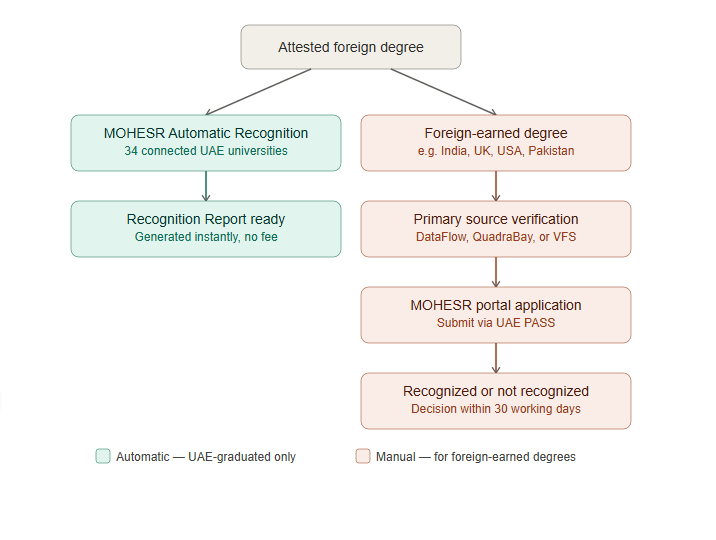
Before you pay for anything, check if you even need to apply manually. In January 2026, MOHESR launched an Automatic Recognition system for graduates of an initial group of 34 UAE-based universities (often referred to as the “Elite 34” in industry coverage). If your degree is from one of these connected institutions, your recognition record is generated the moment your degree is conferred no DataFlow verification, no manual application, no fee. You’d simply log into the MOHESR portal with UAE PASS and download your Recognition Report directly.
Here’s the part worth being very clear about, because several guides leave it ambiguous: Automatic Recognition applies to graduates of those specific UAE institutions — not to foreign degree holders. If your MBBS, B.Tech, or any other degree was earned in India, the UK, the US, Pakistan, or anywhere outside that connected list, this system does not apply to you, no matter how prestigious your university is. You’ll need the full manual route below, the same as always.
Step 2: Primary Source Verification (DataFlow, QuadraBay, or VFS Global)
For everyone going through the manual route, this is where the process actually starts, and it’s the stage most applicants underestimate for how long it takes.
- Create an account with your ministry-accredited verification partner DataFlow Group and QuadraBay are the two most commonly used for MOHESR cases; VFS Global also operates as an authorized verification channel for some case types.
- Select the correct authority (MOHESR, for a university degree not MOE, which handles Grade 12/school certificates only) and your country of study.
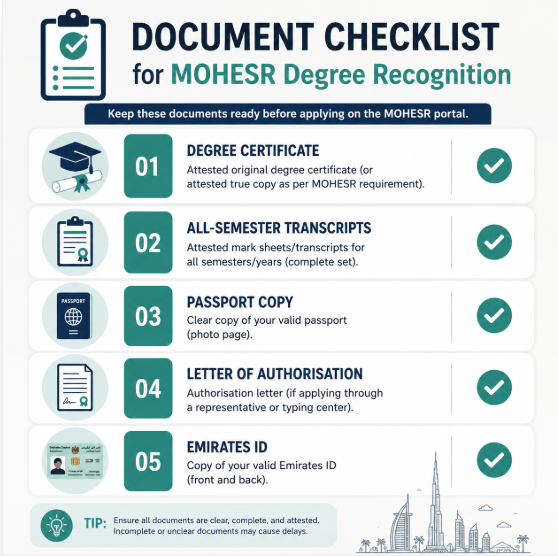
- Upload your documents: passport copy, degree certificate, complete transcripts or mark sheets (all semesters, not just the final year partial transcripts are a common cause of delay), and a signed Letter of Authorisation, which the portal generates for you to sign digitally and which gives the verification partner permission to contact your university directly.
- Pay the verification fee by debit or credit card typically in the AED 300–1,500 range depending on your country and how many documents need checking.
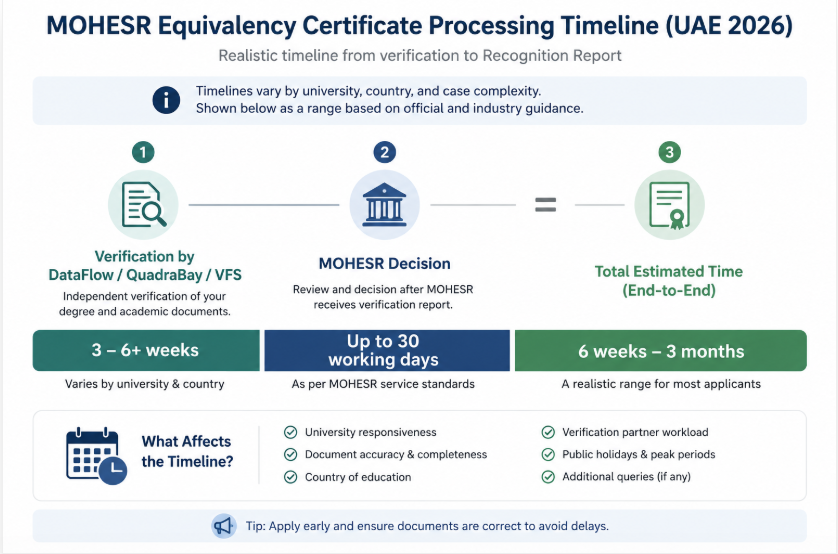
- Wait for your university to respond. This is the step that actually determines your timeline. Large, high-volume institutions with dedicated verification desks think AIIMS-tier or globally ranked universities often confirm within two to three weeks. Smaller state universities or newer private colleges, especially ones without a dedicated verification contact, can take six weeks or longer. If it’s been over a month with no update, it’s worth contacting your university’s registrar directly rather than waiting indefinitely.
Once verification completes, you’ll receive a Verification Report confirming your degree and institution are genuine. Keep this you’ll need the reference number for the next step.
Step 3: The MOHESR Portal Application
With your Verification Report in hand, move to the MOHESR e-services portal itself.
- Log in with UAE PASS. If you don’t already have one, you’ll need to register this requires a valid Emirates ID, GCC ID, or passport, and the UAE PASS app itself (available on Google Play and the App Store).
- Select the “Recognition of University Certificates” service and enter your verification reference number and date of birth the portal auto-fills some details from your Verification Report at this point, so double-check them against your actual documents rather than assuming they’re correct.
- Upload the full document set: your attested degree certificate, complete transcripts, the DataFlow/QuadraBay/VFS verification report, a valid passport copy, and your Emirates ID if you’re already a UAE resident.
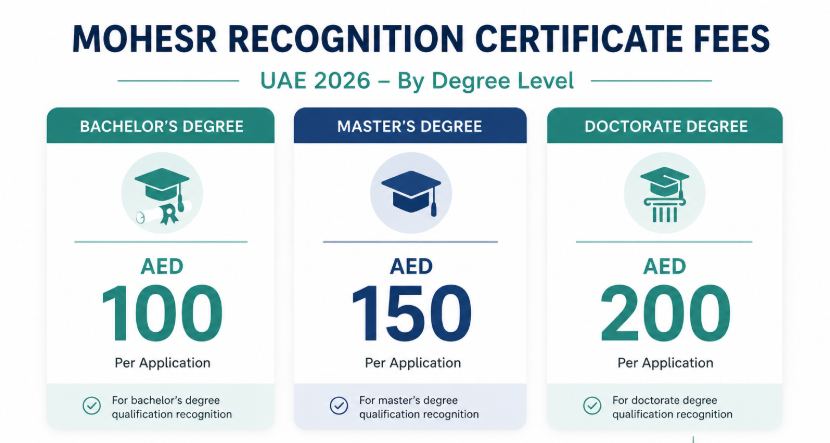
- Pay the government recognition fee, which is tiered by qualification level: AED 100 for a bachelor’s, AED 150 for a master’s, AED 200 for a doctorate. One detail worth knowing before you apply for a master’s or doctorate: MOHESR generally won’t recognise a postgraduate qualification unless the underlying bachelor’s degree has already been recognised if you haven’t gone through this process for your bachelor’s, budget time for that first.
- Submit and save your reference number this is what you’ll use to track your application status on the portal going forward.
Step 4: What Happens While You Wait
MOHESR states a standard processing time of up to 30 working days for a decision, run in parallel with (not after) whatever remains of your verification timeline if it wasn’t already complete. During this window, you may be contacted for additional documents if so, respond within roughly 30 days, since missing that window closes the application automatically and means starting over, fees included.
The outcome arrives as one of two results: Recognized or Not Recognized. If recognized, you can download your Recognition Report the modern equivalent of the old paper equivalency certificate directly from the portal, often with a QR code an employer or authority can use to verify it independently.
If You’re Rejected: The Reconsideration Process
A “Not Recognized” outcome isn’t necessarily final. MOHESR allows applicants to apply for reconsideration within three months of the decision. Before resubmitting, it’s worth understanding what typically drives a rejection in the first place, since reapplying without addressing the underlying issue just repeats the outcome:
- Institutional accreditation gaps MOHESR checks whether your university was accredited during your specific study period, not just today, which catches out graduates of institutions that gained or lost accreditation status after they enrolled.
- Undisclosed distance or online learning if your degree involved distance education, this needs to be declared upfront with supporting approval from your home country’s distance-education regulator; discovering it after the fact reads as a discrepancy, not a technicality.
- Name mismatches across your certificate, passport, and application form.
One point worth knowing: fees are non-refundable regardless of outcome, and a previous verification report done for a different purpose DHA licensing, a bank, an immigration application cannot be reused for a MOHESR submission. Each authority requires its own fresh verification, even if it’s the same degree and the same you.
A Note for High-Ranking Universities
A handful of industry guides mention that graduates of globally top-ranked universities (commonly cited as top-200 lists) sometimes see a simplified verification path with fewer supporting documents required. This isn’t something we could independently confirm against MOHESR’s own published material, so treat it as a possibility worth asking your verification partner about rather than something to rely on if it applies to your case, it’s a pleasant surprise rather than a plan.
What’s Confirmed vs. What’s Commonly Reported
To be transparent about where these figures come from: the recognition fee tiers (AED 100/150/200 by qualification level), the 30-working-day standard processing window, and the three-month reconsideration period are drawn from MOHESR’s own service description. The verification timelines (two to three weeks for large institutions, six-plus weeks for smaller ones) and the AED 300–1,500 verification cost range are patterns reported consistently across multiple attestation and verification providers, not a figure MOHESR itself publishes actual cost and timing depend on your country, institution, and case complexity. Given how often ministry procedures shift, it’s worth confirming current fees and requirements directly on the MOHESR portal before you budget or plan around any specific number here.
FAQs
Do I need to apply through MOE or MOHESR?
MOHESR, for any university-level qualification diploma, bachelor’s, master’s, or doctorate. MOE handles Grade 12/school-level equivalency only.
Can I track my application after submitting?
Yes both the DataFlow/QuadraBay verification stage and the MOHESR portal application give you a reference number you can use to check status online.
What if my university isn’t found in the verification partner’s database?
This is common for smaller or lesser-known institutions and doesn’t mean your degree can’t be recognised it usually just means the verification partner needs to contact the university directly for the first time, which can extend the timeline. It’s worth reaching out to your university’s registrar proactively to speed this along.
Is a Recognition Report the same thing as an equivalency certificate?
Functionally yes it’s the current, officially correct name for what most people still call an equivalency certificate. If you see either term used, they refer to the same outcome.
Can I apply for recognition before my degree is attested?
The safest assumption, and the one consistent with most current guidance, is no treat attestation as a prerequisite. As noted above, there’s some conflicting guidance suggesting the verification stage alone may not require it; confirm with your verification partner if this distinction matters for your timeline.
How long should I realistically budget for the whole process?
If your degree isn’t from one of the Automatic Recognition institutions, budget for verification (roughly three to six-plus weeks, depending on your university) plus up to 30 working days for the MOHESR decision realistically six weeks to three months end to end, on top of whatever attestation took beforehand.
Getting Both Steps Right the First Time
Most delays in this process trace back to one of two points: an attestation chain that’s incomplete or done out of order, or a verification stage submitted with a missing document. Either one resets your timeline to zero, fees included.
Three things worth acting on before you start:
- Confirm Automatic Recognition doesn’t apply to you first — it’s easy to assume a top university qualifies; it only does if it’s on MOHESR’s specific connected list.
- Start verification the moment attestation is done, not weeks later — university response time is the single biggest variable in your total timeline.
- Upload every semester’s transcript, not just the final year — partial transcripts are one of the most common, and most avoidable, causes of delay.
Green Line Attestation’s MOHESR qualification recognition service handles both stages end to end confirming your documents are attestation-ready, coordinating directly with your verification partner, and preparing your MOHESR portal submission, so nothing comes back asking for something you could have included the first time.